Lea Bars

By Wendy Gabbe Day, Guest Contributor

Chocolate-Chip-Cookie-Bar-4

Raising Vegan Kids—On-the-go Snacks!

My kids love to snack all day long—and truth be told, so do I—so I enjoy making homemade snacks that are nutrient-dense, delicious, and easy to pack along on all kinds of adventures. These bars were inspired by the yummy and oh-so-easy to eat Lärabar brand.

The coolest thing about these bars is the endless flavor possibilities! My daughter, Lea, has some nut allergies, so I typically make these bars with coconut shreds, but you can mix it up and add in any kinds of nuts or seeds and any dried fruit you have on hand. Spice things up with a little orange or lemon zest, cinnamon, cocoa powder, berries, or beet juice for color—create your own original flavor!

Not only are these bars tasty and quick to make, they are a fun art project for the kids. Chop them into bite-sized bars, roll them into balls, create fun shapes with cookie cutters, or decorate with chocolate chips—let your imagination and taste buds run wild.

Chocolate-Chip-Cookie-Bar-Hand-1

Lea Bars

Yields 12-20 bars.

Ingredients

  • 1 ½ cups rolled oats
  • 1 ½ cups coconut shreds
  • ⅔ cup dates (lightly packed)
  • 1 teaspoon vanilla
  • 5-7 tablespoons water
  • 3 tablespoons chocolate chips (optional)

Directions

  1. Place all the ingredients except water and chocolate chips in the food processor and process until finely ground.
  2. Add 1 tablespoon of water at a time until mixture sticks together. Add as much water as needed.
  3. On a cutting board, form the mixture into a rectangle, press in chocolate chips, and cut into bars, squares, or roll into balls.
  4. Keep refrigerated and enjoy!

Recipe Tips/Variations

  • We also love making Chocolate Orange Lea Bars! Add in 3 tablespoons of cocoa powder, 1 tablespoon of orange zest, and 2 extra dates to the ingredients above, and proceed with step 1.

Video: PB & J Stuffed French Toast

By Lori Stultz, Communications Manager

What do you get when you combine your favorite childhood lunch with a weekend breakfast favorite?

Peanut Butter and Jelly Stuffed French Toast!

Get your skillets ready and be prepared for the perfect balance of sweet and savory. Thanks to Kim Sujovolsky at Brownble, you’re going to have a new favorite breakfast meal!

PB & J STUFFED FrENCH TOAST

PB & J Stuffed French Toast

Yields 4 servings.

Ingredients

  • 1 tablespoon ground flaxseeds
  • 3 tablespoons water
  • 1 ½ cups non-dairy milk
  • A pinch of salt
  • 1/3 cup flour
  • 1 ½ teaspoons vanilla extract
  • 8 slices of your favorite sandwich bread
  • 6 tablespoons peanut butter
  • 6 tablespoons of your favorite jam or jelly
  • A bit of oil or non-dairy butter for the pan

For Serving

  • Fresh fruit (optional)
  • Maple syrup

Directions

  1. Whisk together the ground flaxseeds and water in a small bowl. Set it aside and let it become thick, like a gel.
  2. In a deep dish, whisk together the milk, salt, flour, and vanilla.
  3. Add the flaxseed gel to the milk mixture and whisk until combined.
  4. Make your peanut butter and jelly “sandwiches” by adding some peanut butter and jelly or jam to one piece of bread and then topping it with another piece of bread. Do it just like you were making peanut butter and jelly sandwiches. You’ll have 4 sandwiches total.
  5. Heat a very non-stick pan on medium-high heat and coat it with the oil or non-dairy butter.
  6. Place a sandwich in the batter and let it soak in some of the liquid, turning it a couple of times. Then immediately transfer it to the hot pan.
  7. Cook until golden and then flip. Remove from the pan when golden on both sides.
  8. Repeat with the remaining sandwiches or do them all at once in an electric griddle or on multiple pans.
  9. Cut them in half, arrange them on a plate, and top with fresh fruit, if desired, and some maple syrup. Enjoy!

Video: Interview with VO Executive Director, Jack Norris, RD

Did you know Vegan Outreach’s cofounder and Executive Director, Jack Norris, is a Registered Dietitian (RD)? In this video he talks with Paul Kelly of Raw and Cooked Vegan about a wide range of vegan nutrition topics—and more!

Jack describes how a fishing trip led him toward a vegan lifestyle. He covers various vegan nutrition topics, including the importance of eating foods high in protein and calcium. He also discusses the welcoming approach to veganism that Vegan Outreach uses to make the lifestyle mainstream.

Raw and Cooked Vegan Interview


Chocolate Chip Cookie Dough Pudding

By Wendy Gabbe Day, Guest Contributor

Wendy Gabbe Day

Wendy Gabbe Day is a proud mama of two vegan kids, the author of Scatter Vegan Sweets, a vegan cooking instructor, food blogger at Lively Days, co-producer of Vegan: Everyday Stories, and former coordinator of Portland, OR’s annual VegFest. Wendy has been vegetarian since birth and a vegan since the age of five. She played Division 1 college basketball at the University of California, Irvine and loves to be outdoors and active with her family in Northern California.

Raising Vegan Kids — Sneaking in Extra Beans!

I love sneaking extra beans into my kids’ meals and snacks when they least expect them. Did you know that beans are nutritional powerhouses? They’re packed with protein, fiber, B vitamins, iron, magnesium, potassium, and much more!

I often blend navy beans into pasta sauce and serve it over noodles and veggies. If you enjoy baking, the addition of garbanzo bean flour creates a nice texture—here’s my go-to banana bread. And I’ve even mashed navy beans into my kids’ oatmeal. Shhh, don’t tell!

My kids love it when I whip up a batch of this protein-rich, date-sweetened pudding for dessert—or breakfast! We dip apple slices into it or eat it by the spoonful. It’s an easy way to incorporate more beans into everyone’s diet! Thank you to Chocolate Covered Katie for inspiring this creation.

Chocolate Chip Cookie Dough Pudding 1

Chocolate Chip Cookie Dough Pudding

Yields about 3 cups.

Ingredients

  • 2 cups cooked navy beans (or other white beans)
  • ⅔ cup dates (pitted)
  • ½ cup water
  • ⅓ cup peanut butter, or other nut butter (also see Recipe Tips/Variations below)
  • 2 teaspoons vanilla
  • Dash of salt
  • ¼ cup chocolate chips (or raisins)

Directions

  1. Place all the ingredients except chocolate chips (or raisins) in a food processor and process until smooth and creamy—scraping down the sides as needed. Add more water if needed for a smoother texture.
  2. Spoon the pudding into a bowl and stir in chocolate chips (or raisins).
  3. Pudding will firm up in the refrigerator.

Recipe Tips/Variations

  • For a nut-free version, coconut butter works nicely.

Chocolate Chip Cookie Dough Pudding 2


VO Management Hits the Campuses!

By Lori Stultz, Communications Manager

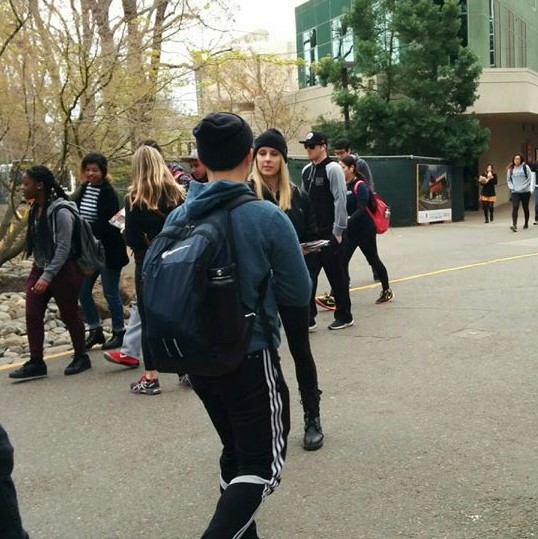
I’ll be the first to admit that here at Vegan Outreach we love to brag about our Outreach Coordinators (OCs). Each semester, our OCs spend endless hours driving from state to state, college campus to college campus, to help raise awareness about the animal abuse in our agriculture system. They forego the comfort of their own homes, stay on other people’s couches, and leaflet in unforgiving and unpredictable weather patterns—I’m looking at you Midwestern and East Coast leafleters!

Equally brag worthy are the individuals who work “behind the scenes” of Vegan Outreach. These hardworking folks make sure our goal of helping as many animals as possible is being met at its fullest potential. The inner-workings of an organization like Vegan Outreach can easily keep a whole team of people working full time—and then some—and many of our staffers actually don’t get the opportunity to leaflet very frequently. That’s why we love to boast about them when they make time to go out and do outreach.

We’ve had a handful of non-OC staff members out there tearing it up this semester, and here’s what they had to say when I asked about their leafleting experiences—

Josie Moody • Office Manager • Sacramento State
Josie Leafleting

“I always get a little nervous before I go, but within minutes my apprehension disappears and I start to enjoy myself! I smile and say thank you to people who take a leaflet, and even to people who decline. As the saying goes, that one life matters to the life that is saved.

It’s encouraging to think of all of the amazing activists I know who go out and do this day-in and day-out, planting the seeds of compassion.”

Roxanne Hill • Community Engagement and Events Manager • Cal State Dominguez Hills
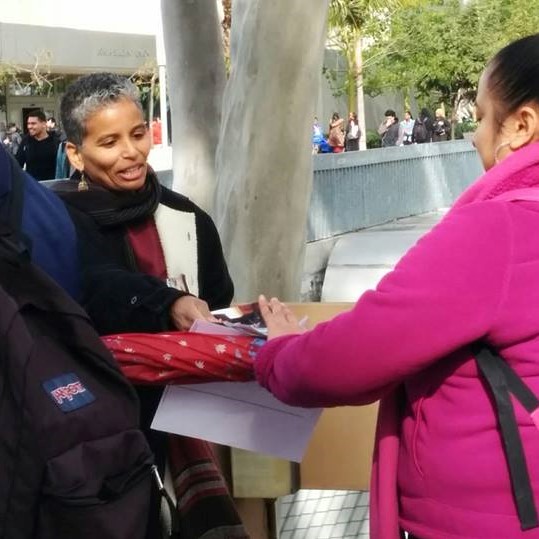
Roxanne Leafleting

“I was excited and a bit nervous as I anticipated my leafleting debut. To my great surprise, I thoroughly enjoyed the experience. It was a lot of fun as I competed with myself, trying to hand out as many leaflets to as many students as possible. Even more surprising was how warm, friendly, and polite the vast majority of the students were—even when declining a leaflet!”

Breege Tomkinson • Director of Finance • Sacramento State

Breege Leafleting

“I didn’t leaflet long (less than two hours), but it was a really good experience. Most students seemed open to taking a leaflet and many said they were already vegan or vegetarian. One student came over and thanked us for what we were doing. At one point, I handed a leaflet to a student whose hands were full because she was carrying a plate of chicken, but she took it. I liked that we were planting a seed about an issue many of these students most likely wouldn’t have thought about that day.”

Lisa Rimmert • Director of Development • East High School, Denver
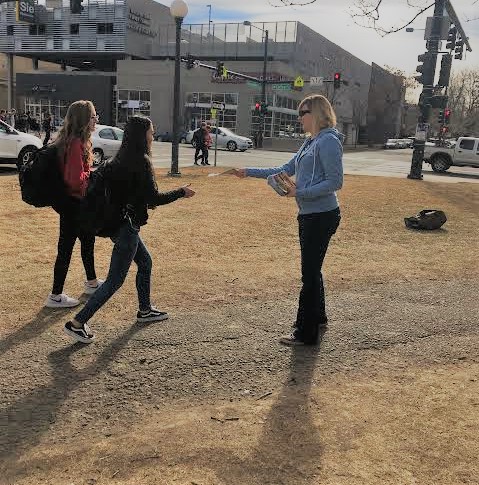
Lisa Leafleting

“The thought of leafleting outside of a high school was a little intimidating—even for an extrovert like me! We ended up passing out 225 leaflets and it felt good walking away knowing that I had planted some vegan seeds.”

Taylor Radig • Campaigns Manager • East High School, Denver

Taylor Leafleting

“On our lunch break, Lisa Rimmert and I went out to a local high school and handed out a couple hundred leaflets to passing students. It only took about 30 minutes out of our day to get lifesaving information into the hands of future change makers.”

Jack Norris • Executive Director • Cal State Dominguez Hills, Pasadena City College, Sacramento State
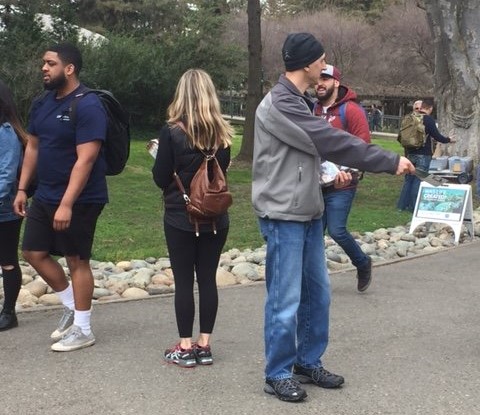
Jack and Breege Leafleting

“It always feels great to get back out there. Leafleting for just 90 minutes a month can reach a lot of people—you never know when you’ll change a life and maybe create the next great animal advocate!”

Steve Ann Chambers • President • Iowa State
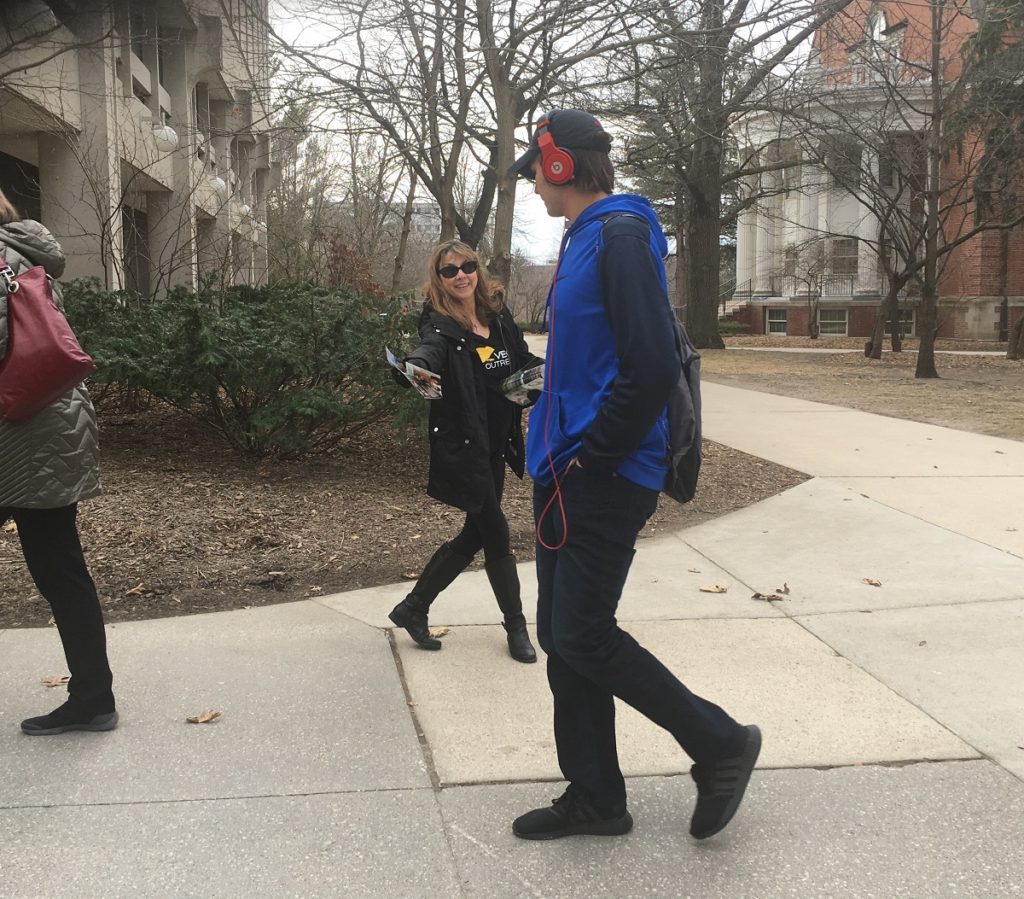
Steve Ann Leafleting

“It was chilly, but we—Patti Rogers-Engelby and Outreach Coordinator John Deetjen—managed to distribute 2,500 Vegan Outreach booklets. We had so many great interactions with students. While we were warming up inside the library (between classes), one young woman came over to me and asked, ‘Are these your booklets? I’m vegetarian and I’m trying to go vegan, so this is great!’ I hooked her up with Vegan Outreach’s Vegan Mentor Program.

It’s incredibly fulfilling to connect with so many interested young people!”

Vic Sjodin • Director of Outreach • Cal State Dominguez Hills
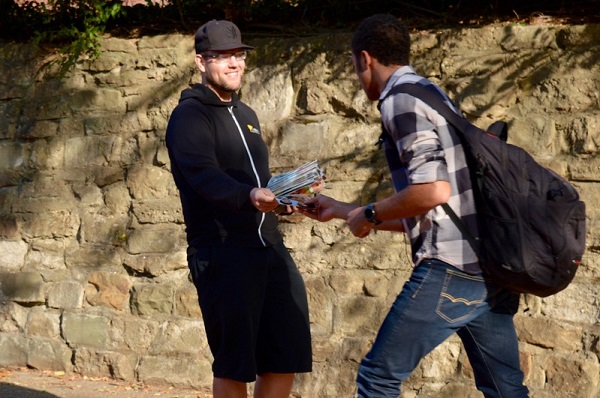
Vic Leafleting

“It brought me great joy to step out from behind the desk to leaflet with Jack and Roxanne at Cal State Dominguez Hills this semester. Eight years of leafleting and nearly 650 different schools, I’d never actually leafleted with the man who started it all. Students were very kind and responded well to the new Compassionate Choices booklet covers, and it’s always great to see so many students reading the booklets. It reinforced the simple, but profound beauty of leafleting to me—that with just a few short hours of your time, you can change several dozen lives forever.”

Kevin Gallagher • Operations Manager • University of Washington

“Given that the Seattle area has been plagued by record winter rains that have greatly impeded leafleting, I’d none too jokingly exclaimed that my primary aim is to avoid having to leaflet in a downpour as it greatly hurts the leaflet take rate—everyone is in too much of a hurry getting from one place outdoors to another indoors to have much patience for taking a leaflet, especially leaflets that are beginning to become sodden. But however much time I have to leaflet—in good weather or not—it’s heartening to have someone take a leaflet so that they can ponder making conscientious changes to their eating habits.”

I think this speaks to the dedication of each and every Vegan Outreach staff member. Let’s give a heartfelt thank you not only to our amazing Outreach Coordinators, but also to the wonderful Vegan Outreach employees who are not always publicly acknowledged for the hard work they’re doing for the animals.


Southwestern Bean and Rice Chili

By Lisa Rimmert, Director of Development

Southwestern Chili

“Can you cook?” It’s a question I never really know how to answer. If qualifying as a good cook simply requires possessing the ability to read and follow instructions, then yes, I can cook. Though some of my high school teachers would scoff reading that! If, on the other hand, it requires being able to create original recipes that taste good, then no, I can’t cook.

Usually, when I cook a meal without a recipe, I end up wishing I had at least glanced at other similar recipes to get an idea of what to do. This chili is a rare exception to that. And despite the fact that I, ahem, meant to make soup, this chili is now my pride and joy! I hope you like it as much as I do!

Southwestern Bean and Rice Chili

Yields 2-3 servings.

Ingredients

  • 1 cup brown rice
  • 2 tablespoons of oil
  • Handful of Beyond Meat chicken strips
  • 1 can pinto beans
  • 1 beefsteak tomato
  • 1 small can tomato paste
  • 2 teaspoons chilis in adobo sauce
  • 1 cup vegetable broth
  • Handful of spinach
  • Salt and pepper (if needed)
  • Vegan sour cream, cheese shreds, and tortilla chips (optional)

Directions

  1. Cook the rice according to directions on package.
  2. Meanwhile, heat 1 tablespoon oil on non-stick skillet and add Beyond Meat strips over medium heat. Cook, flipping as needed until lightly browned and heated through.
  3. Remove Beyond Meat strips from heat and set aside.
  4. Drain the beans and wash and chop the tomato.
  5. Add beans and tomato to skillet and cook until softened.
  6. Add tomato paste and chilis in adobo sauce. Mix well.
  7. Add broth and spinach and continue cooking for 1 to 2 minutes, until spinach is a bit wilted. Remove from heat.
  8. Carefully add rice and bean mixture to food processor and mix well. Add more broth if needed to thin out the chili. Taste and add salt and pepper if needed—make sure you taste first because the adobo sauce and the broth already have salt.
  9. Garnish with vegan sour cream, cheese shreds, and tortilla chips if you like, and enjoy!

Ketchup Baked Home Fries

By Lori Stultz, Communications Manager

Ketchup Baked Home Fries
Photo: Renee Press / Fire and Earth Kitchen

I think we can all agree that there’s something extra special—and tasty—about homemade French fries. Renee Press with Fire and Earth Kitchen puts a spin on these spuds that ketchup lovers are going to drool over!

Ketchup Baked Home Fries

Yields 2-4 servings.

Ingredients

  • 1-2 tablespoons neutral oil (avocado, grape seed, or canola)
  • 5-6 medium Yukon gold potatoes, cubed (no need to peel)
  • 2 cloves garlic, finely chopped (optional)
  • ¼ cup potato starch (or corn starch)
  • ⅛ cup ketchup
  • 1 teaspoon paprika
  • 1 teaspoon salt
  • 1 teaspoon black pepper
  • 1-2 tablespoons freshly chopped parsley (optional)

Directions

  1. Preheat oven to 425°F, lightly oil baking sheet, and set aside.
  2. Cut potatoes into roughly 1″ cubes and place on baking sheet. Cover with remaining ingredients—including ketchup, but not parsley—and use your hands to toss to coat.
  3. Spread into an even layer on baking sheet and bake for 15 minutes. Remove from oven, flip potatoes and bake for another 5-10 minutes.
  4. Serve sprinkled with fresh parsley, if desired, and more ketchup drizzled on top. Enjoy!

You can get Renee’s original recipe here.


Tech Trends That Are Changing the World for Animals—for the Better: Part 2!

By Jen Bravo, Guest Contributor

In part one of our Tech Trends That Are Changing the World for Animals–for the Better!, we shared some exciting technology trends that are benefiting animals—including innovations around the future of protein—hint: it’s cruelty-free!—and how virtual entertainment and immersive experiences are changing how we will relate to animals, learn about them, and be entertained by them.

In this post, we’ll talk about ending animal testing—finally!—and how drones and artificial intelligence are revolutionizing anti-poaching and conservation efforts.

Organ On a Chip
Organ on a Chip (Photo: Vimeo)

Trend #3: Ending Animal Testing

Many of us have been fighting the practice of animal testing for decades. We’ve lobbied to change regulations (here, here, and here), rescued animals from laboratories, and educated our friends and family about buying cruelty-free products. The day is coming, however, when it’s cheaper and more efficient for companies to switch completely to new non-animal testing methods. Over the past few years, the development of human organs “on-a-chip” have begun to revolutionize disease modeling and drug development at an astonishing rate. At the same time, it’s revealing animal testing as the archaic and inaccurate practice that it is.

The Wyss Institute at Harvard University has “engineered microchips that recapitulate the microarchitecture and functions of living human organs, including the lung, intestine, kidney, skin, bone marrow, and blood-brain barrier. These microchips, called ‘organs-on-chips,’ offer a potential alternative to traditional animal testing.” By testing on replicas of human organs, rather than animals with a different physiology, researchers will increase the accuracy of their results, while reducing costs. The Wyss Institute isn’t the only one. Many companies are working through FDA approval processes and continuing to refine their innovations. And it gets better—companies like Emulate are finding ways to emulate the entire human body, opening doors for an improved understanding of how diseases, medicines, and our environment affect us, all without testing on any animals.

If you’re interested in learning more about these new technologies, IndieBio, a San Francisco-based biotech accelerator, will be highlighting Scaled Biolabs, a startup that is “accelerating biologic, gene, and cell therapies using smart microfluidic chips.” You can view IndieBio’s most recent Demo Day—February 9, 2017—here, which features Scaled Biolabs.

Sea Shepherd Drone (Photo: Sea Shepherd Conservation Society)

Trend #4: Drones and Artificial Intelligence

No, this trend isn’t about SkyNet, and the Terminator isn’t coming for you (as far as I know). But if you’re an elephant or rhino poacher, a drone might be. Using drones to fight poaching isn’t new, but they’ve been highly effective, and that effectiveness will continue to improve with the use of smart systems and artificial intelligence. The Black Mambas—the celebrated majority-women anti-poaching unit in South Africa—are using drones to protect rhinos, and the Sea Shepherd Conservation Society is using drones to patrol marine reserves in the Gulf of California. Legendary Captain Paul Watson of Sea Shephard has outfitted all of his ships with drones, arguing that advanced technology is the best way to combat poaching (see the link for “DIY drones” below). And Air Shepherd is using predictive algorithms, originally developed to locate improvised explosive devices (IEDs) to predict where poachers will be located, then sending drones to patrol those areas. Artificial intelligence allows drones to recognize what’s important, saving precious bandwidth, and alerting rangers only when their help is needed. One example is the philanthropic arm of the Dutch company Birds.ai, which provides “intelligent eyes in the sky” to rangers protecting rhinos from poaching.

As predictive modeling and artificial intelligence improve, and as hardware costs of the drones themselves come down—and crafty rangers are able to DIY drones for one-tenth the cost!—our ability to stop poaching before it starts will continue to improve.

We all know that technology moves fast, but these “exponential” technologies—technologies that are improving in performance and decreasing in cost along an exponential curve—can surprise us with the speed at which they take off. So if 2017 has gotten you down, just think that these technologies are getting better and better, and cheaper and cheaper, at an exponential rate. The days of factory farming, zoos and animal shows, animal testing, and poaching are coming to an end…faster than we think.


Call to Action—Take 2 Minutes to Help Get Vegan Options

By Taylor Radig, Campaigns Manager

A few months ago, Vegan Outreach launched a petition asking leading pizza chain California Pizza Kitchen (CPK), to follow the dairy-free trend in pizza and add a vegan cheese option to their menu. Despite thousands of signatures from eager customers wanting to support this option, CPK has remained silent on their future menu additions.

We want to continue to have CPK hear from their vegan and non-dairy customers—letting them know that this option would be successful!

Here are three easy steps you can take to make this happen:

Call your local California Pizza Kitchen

CPK Locations

When you call, ask to speak with the restaurant manager. Tell them how excited you would be if CPK added a vegan cheese pizza to their menu!

Show them on social media

Jona and Jack Norris

Tag #CaliforniaPizzaKitchen and #CPK to make sure your voice is heard.

Share the Petition

CPK Petition

Sign the petition at Veganoutreach.org/CPK and make an even greater impact by sharing the petition on Facebook and Twitter!

Together, we can make this vegan cheese pizza happen! Thank you in advance for your help!


Servin’ Up Seitan Wraps at Alamogordo Health and Wellness Fair

By Victor Flores, Greater New Mexico Community Engagement and Events Coordinator

Attendees-family

In February, the Alamogordo Health and Wellness Fair invited my family to participate in their annual health fair at New Mexico State University Alamogordo in Alamogordo, NM. After learning that the vendors and speakers needed to bring their own lunch, we saw a perfect opportunity to “wow” them with a vegan meal. Even though it required food for 100 people, we accepted the challenge!

There’s a vegan-friendly restaurant in nearby El Paso, TX, named Eloise that makes its own seitan that is absolutely delicious. We ordered 100 of their El Graco seitan wraps as the main entrée and rounded out the meal with veggie chips, apple braid strudel for dessert, and water infused with strawberry, kiwi, lime, and orange.

Besides having a booth set up with tons of information on the benefits of plant-based nutrition, we had an area to give out information to the vendors and speakers we fed. We intentionally set up a table in a separate area so they wouldn’t be distracted with the noise. When the speakers and vendors came to pick up their food, we made sure that everyone who got a seitan wrap also took a Vegan Outreach pamphlet. We also posted a menu so everyone knew what they’d be eating. Most were excited to try the wrap, while others were skeptical.

Boxed Lunches 2

Lunch Line 2

Lunch Line 1

After all the meals and pamphlets were handed out, I took a stroll around the entire fair to visit with the vendors while they were eating. I’m not exaggerating when I say that everyone was blown away! Some couldn’t believe the meal was vegan. Many swore the seitan had to be some type of meat since the flavor and texture were so delicious. I didn’t come across a single person who didn’t like the meal.

Many of the vendors and speakers came to our booth after lunch to request more information and vegan recipes. Several asked for our contact information to see if we could possibly do cooking classes and other community activities These groups varied from local health organizations to an organization that mentors juveniles in the juvenile detention system.

Attendee with lunch and leaflet

If you’re trying to create more vegans in your community, keep your eyes open for opportunities like this. Vegfests are fun but we’re often preaching to the choir. Look for health fairs and festivals at local schools. Offer them free vegan food and then sit back and watch lives change!